
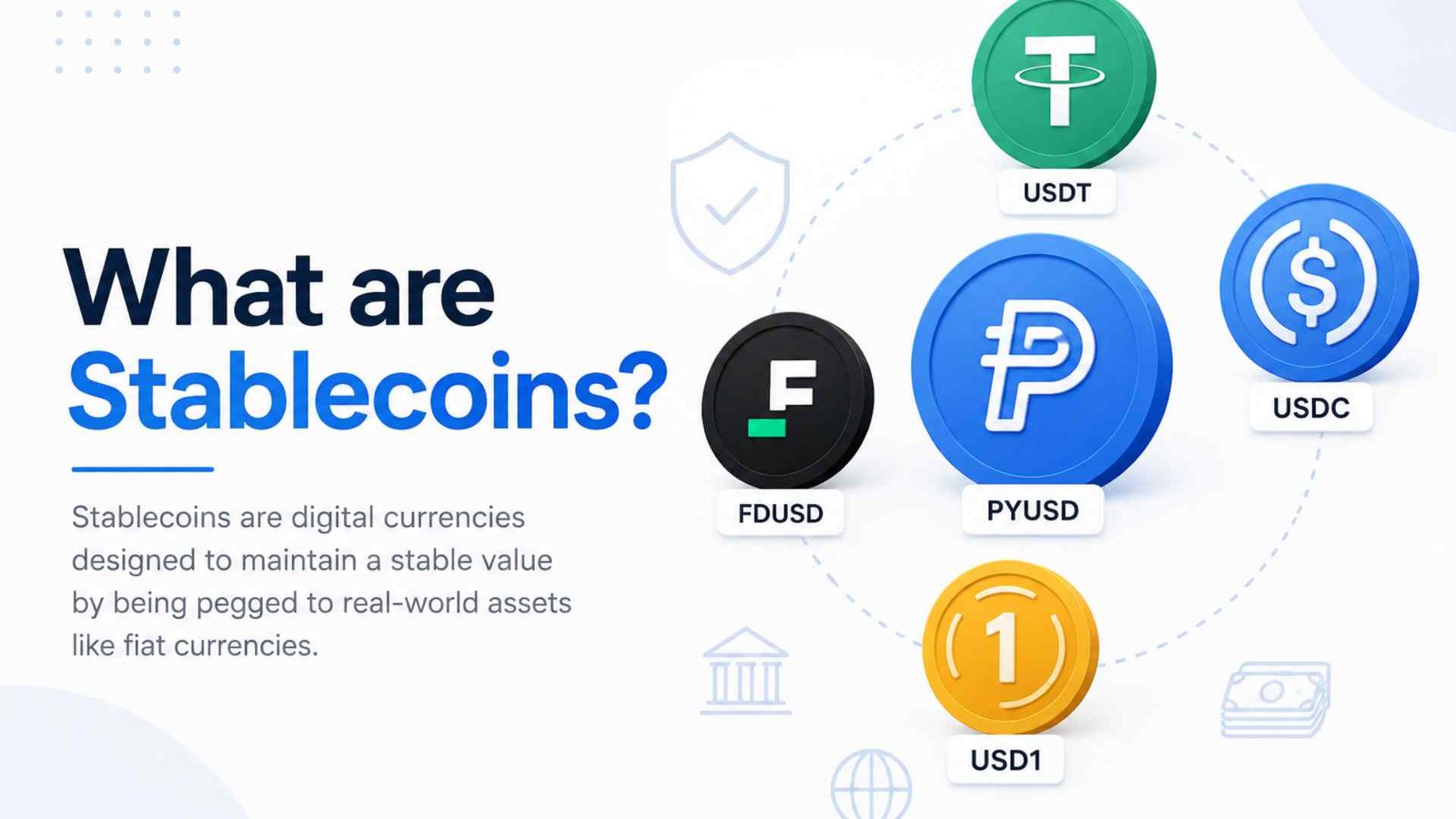

A stablecoin is a cryptocurrency whose value is pegged to an underlying asset, so its price remains stable relative to that asset.
These assets can be fiat currencies like the US Dollar (USD), Euro (EUR), or Swiss Franc (CHF), precious metals like Gold, or commodities like a barrel of oil.
The basic goal is to get a cryptocurrency whose value does not fluctuate.
Definition
A stablecoin is a cryptocurrency whose value is fixed. The fixed value is achieved by pegging it to an underlying asset, such as a fiat currency or a commodity like gold or oil. As a result, its value does not fluctuate like other cryptocurrencies such as Bitcoin and Ethereum.
Working
Stablecoins work in a very simple way: they keep their value constant, i.e., fixed with reference to another asset. These assets can be fiat currencies, gold, oil, or any other commodity.
A stablecoin can maintain its peg in one of two ways: either it can make a reserve of the underlying assets and issue stablecoins only as per the reserve, or it can create a mechanism that controls the demand and supply to stabilize the value of the stablecoin. The working of both of them is explained in the relevant sections later. There is also a hybrid way discussed later.
Types of Stablecoins
There can be several classifications on how stablecoins should be divided; however, I have presented the top 3 most commonly used ones.
Collateralized Stablecoins
These are the stablecoins that are backed 100% by underlying assets such as fiat currency (US Dollar or Euro), or by commodities (gold or oil).
Working
Their value is kept fixed by issuing only that many stablecoins as there are reserves.
They are the most commonly found stablecoins.
Examples
- USDT, pegged to the US Dollar, backed by treasury bonds, cash, and fixed income assets.
- USDC, also pegged to the US Dollar, backed by treasury bonds, cash, and fixed income assets.
- USD1, also pegged to the US Dollar, backed by treasury bonds, cash, and fixed income assets.
- XAUT, pegged to the value of 1 ounce of Gold, and backed by physical gold.
- EURT, pegged to the Euro, backed by treasury bonds, cash, and fixed income assets.
Algorithmic Stablecoins
These are the stablecoins whose value is pegged to a certain physical asset such as the US Dollar, but their value is not backed by any physical asset. Rather, they are kept at a fixed value by controlling their supply.
Working
During phases of high demand, excess coins are minted, which is enough to control the demand; as a result, the price remains stable.
Similarly, during phases of low demand, their supply is controlled by burning excess tokens, which again brings the price to an equilibrium. Mostly, these operations are automated and usually handled by smart contracts.
Further, there is usually a pool of assets that is used to address excess demand and supply, acting as a buffer.
Examples
Terra’s UST was one of the most prominent examples of algorithmic stablecoins. Its value was controlled by a systematic burn-and-mint mechanism paired with its parent token, LUNA.
Hybrid Stablecoins
Hybrid stablecoins are a special category where their value is both partially backed, and they also depend on algorithms to maintain their value.
An example of such a coin is DAI, which has a reserve asset pool of Bitcoin, Ethereum and other cryptocurrencies but also have a algorithm to adjust demand and supply to maintain fixed price.
Special Case: Yield-Bearing Stablecoins
Yield-bearing stablecoins are not exactly stablecoins but are more like bearer bonds. They are relatively scarce as compared to traditional stablecoins in usage because of their limited acceptance.
Working
These stablecoins have an inbuilt mechanism that is distributed automatically to their holders, usually via an airdrop.
Each yield-bearing stablecoin has a smart contract where the rules of the yield are hard-coded. These rules can be related to holding period, min period to qualify, etc. As a result, the yield is generally auto-credited to the deserving holder.
An Example of Yield-Bearing Stablecoin
Binance’s BFUSD is such a yield-bearing stablecoin launched by the exchange, which gives a yield of 2.5% annualized rate of return.
Did you know? It was alleged that inflated yields (up to 40%) on the yield-bearing stablecoin BFUSD caused the October 10, 2025, crash in crypto markets, resulting in nearly $19 billion in losses.
Yield-Bearing CBDC
China launched a yield-bearing CBDC in June 2026, which will automatically credit yield to a user who holds it for a certain amount of time. Although critics allege that these will result in a flight of money out of the banks, they are still considered an evolution of money.
A similar proposal is already in the making in the USA.
Examples
1. Tether’s USDT
Tether issues the USDT stablecoin, which is pegged to the US Dollar at a 1:1 ratio, meaning both are worth $1.
However, this may change depending upon the demand and availability of the US Dollar. Most of the time, I have seen USDT trade at a 5%-10% premium to $1.
The reserves of USDT consist of cash and cash equivalents, such as US Treasury Bonds and private debt, among other fixed-return assets. However, there has been doubt about the quality of reserves since Tether does not allow any independent third-party audit.
2. Circle’s USDC
Circle issues USDC which is a collateralized stablecoin. The collateral is issued as per NYDFS standards and is fully auditable by third parties.
Till 2024, the cryptocurrency used to be on an equal market share with USDT, however, duing the Silicon Valley Bank collapse, it lost $3 billion worth of collateral temporarily, causing an exodus of users, and making it lose significant market share.
3. Maker DAO’s DAI
DAI is a hybrid stablecoin issued by Maker DAO, one of the prominent decentralized organizations in crypto markets.
4. PayPal’s PYUSD
PayPal launched the PYUSD stablecoin to make its own payments business more efficient. It is a fully collateralized USD based stablecoin.
The coin soon landed into controversy after launch because of a clause in its smart contracts which enabled it to freeze and wipe user wallets, significantly challenging the principles of decentralization which says users have 100% control over their money.
As a result, it lost the headstart it had and now has been competing for dominance again.
Frequently Asked Questions
1. Are stablecoins the same as CBDCs?
No, stablecoins can be freely traded across multiple chains and have restrictions only regarding AML. However, CBDCs can only be used in their native blockchain.
Further, any private entity can issue a stablecoin if it has sufficient collateral or a robust algorithm; however, only governments can issue CBDCs.
Disclaimer: Stablecoin News aims to provide information only, and our information does not constitute trade or investment advice. Kindly consult a financial advisor before trading or investing.
